
Docks of Orlando · Commercial Waterfront Construction
Commercial Waterfront Construction
Docks of Orlando handles commercial and multi-slip waterfront projects — docks, decks, walkways, and piers for properties that need durable, code-conscious construction and dependable project management. Commercial waterfront construction is our most involved service path: the structures are larger, the loads are heavier, the permitting and access considerations are more complex, and the scheduling has to work around guests, tenants, and operations. It is the same craft as our residential work, scaled to the demands of a property that serves the public.
This page explains what commercial waterfront construction includes, who it suits, the options involved, how the process works, what to expect, and the questions property owners and managers ask most. Commercial projects often share structure with our residential custom dock work but carry their own code, access, and scheduling requirements; we walk you through those based on your property. See our commercial project work on the commercial portfolio page.
What commercial waterfront construction includes
A commercial build covers the waterfront structures a property needs to serve guests, tenants, or operations. When we scope a commercial project, the work typically covers the following.
- Commercial dock and pier construction built for high-traffic, durable use.
- Multi-slip and shared-use structures for properties that serve more than one boat or user.
- Walkways and access decks that connect buildings, docks, and shoreline.
- Permitting coordination for commercial sites, which often carry additional code and access considerations.
- Project scheduling and coordination that works around guests, tenants, and operations.
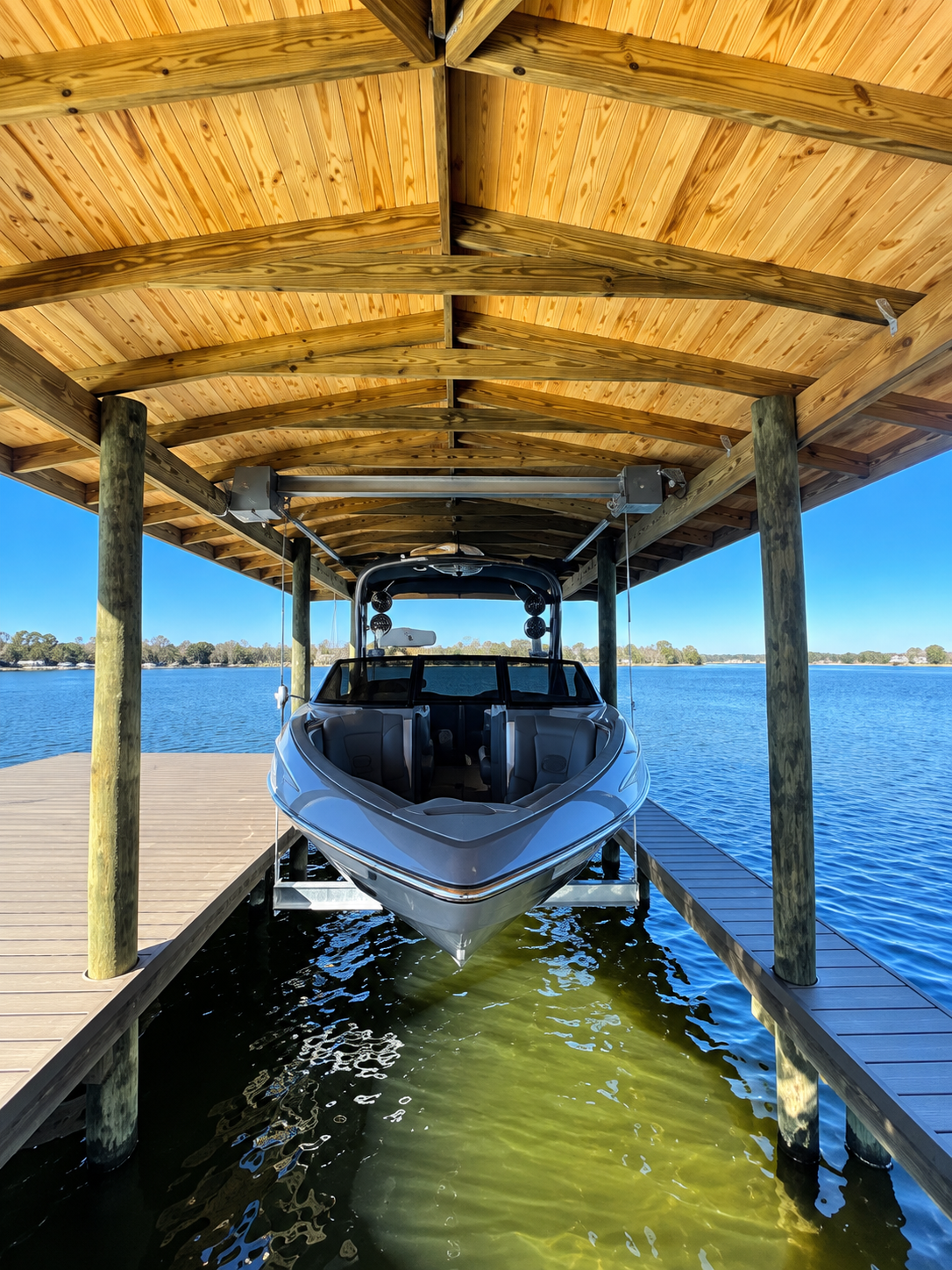
The difference between commercial and residential work is mostly about demands. A commercial structure carries more foot traffic, more boats, and more wear than a private dock, so the framing is heavier and the surfaces are more durable. Permitting often involves additional code and access considerations — public access, occupancy, and the specifics of a commercial site — which we coordinate as part of the build. And the scheduling has to minimize disruption to operations, guests, and tenants, which is its own kind of planning. We build for those demands rather than treating a commercial project like a scaled-up residential one.
Who commercial waterfront construction is for
Commercial construction suits properties that need waterfront access for guests or tenants — a marina, a multi-slip residential property, a commercial waterfront with public access, a resort or rental property with a dock, or any site where the structure serves more than one household. It is also the right path when a commercial structure needs repair, replacement, or expansion and the work has to be coordinated around ongoing operations.
It is also the right choice when a property owner needs a contractor who can coordinate permitting and construction together — not just build the structure, but manage the project through the code and access requirements a commercial site carries. That coordination is a meaningful part of commercial waterfront work, and it is one of the things we handle rather than leaving to the property owner.
Options and materials in a commercial build
Commercial structures use the same families of materials as residential ones — wood and composite decking, aluminum and wood railings, marine-grade fasteners and hardware — but selected and sized for heavier use. The decking surface is chosen for durability and foot traffic as much as appearance; framing is sized for the loads a commercial structure carries; railings and stairs are built for safe public access. Where a commercial dock carries boat lifts, the framing is engineered for the combined load. The specifics are easier to weigh against the demands of your property in person; our Materials & Options page covers the material categories in more detail.
Walkways and access decks are their own part of a commercial build. Connecting buildings, docks, and shoreline safely — with proper grading, railing, and lighting — is what makes a commercial waterfront usable for the people who move across it every day. We design and build those connections as part of the project rather than as a separate afterthought.
Commercial vs. residential waterfront work
Commercial structures carry more traffic, more boats, and more wear than a private dock, so framing is heavier, surfaces are more durable, and permitting often involves additional code and access considerations. We build for those demands and coordinate the scheduling around your operations rather than treating a commercial project like a scaled-up residential one.
Benefits and limitations
The benefit of commercial construction is a waterfront built for its actual use. A commercial dock, walkway, or pier that is framed, surfaced, and permitted for the traffic it carries lasts longer, stays safer, and serves guests and tenants better than a structure that was not designed for that load. And because we coordinate permitting and scheduling as part of the project, the property owner does not carry that management burden alone.
The limitation is complexity. Commercial projects carry more code, access, and scheduling considerations than residential ones, and the timeline depends more on permitting and on coordinating around operations. The investment is larger, and the structure is more affected by conditions outside anyone’s control. We are straightforward about those variables so you can plan around them rather than be surprised by them.
How the commercial process works
1. Conversation and site assessment
We talk through the property’s needs — traffic, boats, access, operations — and assess the site and the conditions the structures have to live in.
2. Design and material selection
We design the docks, walkways, and piers and select materials sized for commercial use, with honest trade-offs on cost, maintenance, and lifespan.
3. Permitting coordination
We coordinate permitting and engineered-plan requirements for the commercial site, which often carry additional code and access considerations. Permitting timelines depend on your location and the scope of work, so we walk you through what to expect for your specific project. Learn more on our Design & Permitting Process page.
4. Construction
Our crew builds the structures — docks, walkways, piers, multi-slip and shared-use — with attention to every detail, coordinating scheduling around operations.
5. Final walkthrough
We walk the finished project with you, confirm it is ready for use, and answer questions about care and next steps.
Preparation and what to expect
Before we start, it helps to know the property’s usage — how many boats, how much foot traffic, what access the structures need to provide — and any operational constraints on scheduling. During construction, expect framing, decking, and walkway activity at the waterfront, material deliveries, and the day-to-day movement of an active build. Because commercial projects often run alongside operations, we coordinate scheduling to minimize disruption to guests, tenants, and the property’s routine. And because permitting is part of a commercial build, some of the schedule is set by the permitting authority rather than by us; we keep you informed as that progresses.
Maintenance and aftercare
A commercial waterfront is maintained like any dock or deck, but more often — the traffic and the wear are higher, so the cadence of inspection and care is higher too. Regular inspections, cleaning, sealing, hardware service, and lift and accessory servicing keep a commercial structure safe and serviceable, and an inspection after any major storm is especially important for structures the public uses. Ongoing care is available through our Dock Maintenance service. We set honest expectations for the upkeep a commercial structure needs so it stays safe and serviceable for the people who use it every day.
Local considerations
Central Florida’s waterways, sun, and storm season shape what a commercial structure has to handle, and permitting requirements vary by waterway, location, and the access a commercial site provides. Our published coverage includes Orange, Osceola, Seminole, Lake, and Volusia counties; we confirm coverage for individual properties before committing to a build. Explore the broader region on our Service Areas page.
Why choose Docks of Orlando
We build commercial structures for the traffic and wear they actually carry, we coordinate permitting and scheduling as part of the project, and we plan the work around your operations rather than around ours. You can see commercial waterfront work in our commercial portfolio and the rest of our work in the main portfolio, and learn more about the company on our About page.
Planning a project?
Tell us about your shoreline and goals. We’ll assess the conditions, explain the options, and send a free, no-obligation quote.
Commercial Waterfront Construction — Frequently Asked Questions
Straight answers to the questions customers ask most about commercial waterfront construction.
Yes. We coordinate permitting and engineered-plan requirements for commercial sites as part of construction. Commercial projects often carry additional code and access considerations, which we walk you through based on your property.
Commercial docks and piers, multi-slip and shared-use structures, walkways, and access decks — built for properties that need durable, high-traffic construction and dependable project scheduling.
We plan commercial project scheduling to minimize disruption to guests, tenants, and operations, and we coordinate timing with your team.