
Docks of Orlando · Custom Dock Design & Construction
Custom Dock Design & Construction
Docks of Orlando designs and builds custom residential docks from the ground up — tailored to your shoreline, water depth, boat size, and the way you use the water. Custom dock design and construction is our most involved service: it begins with a site assessment, moves through layout and material selection, coordinates permitting and engineered-plan requirements, and ends with a finished structure built for Central Florida conditions. Because every waterfront is different, a custom dock is designed around your property rather than built from a single template.
This page explains what custom dock construction includes, who it suits, the options and materials involved, how the process works, what to expect, how to care for a finished dock, and the questions customers ask most. If your existing dock is sound but weathered, Dock & Deck Renovation may be a faster path; if it is damaged, Dock Repair & Storm Restoration is the right starting point. We inspect first and tell you honestly which path makes sense.
What custom dock construction includes
A custom build is the full scope of work required to put a new dock on your shoreline. When we scope a custom dock, the work typically covers the following elements.
- An on-site property and shoreline assessment to read the conditions your dock has to live in.
- Custom dock layout and design shaped to your boat, your boarding routine, and your shoreline.
- Material and finish selection for the decking, railings, and structural components.
- Permitting and engineered-plan coordination so the project is built to code for your waterway.
- Piling, framing, and deck construction by our crew.
- A final walkthrough and care guidance so you know how to look after the finished structure.
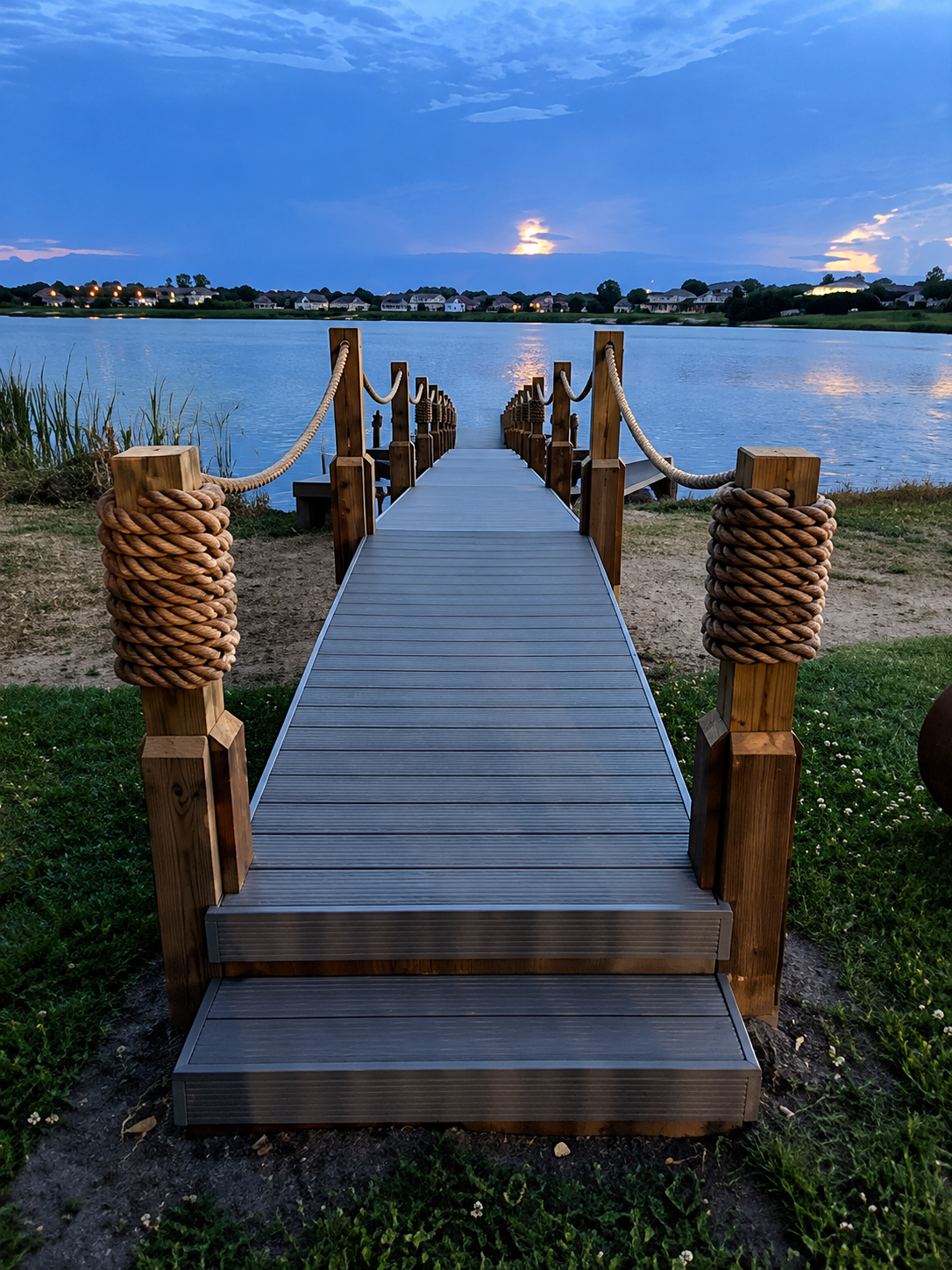
The word “custom” matters here. A standard dock is built from one set of assumptions; a custom dock is designed around the realities of your lot — the slope of the shoreline, the depth of the water at your boarding point, the size and type of boat you keep, the prevailing wind and sun exposure, and the features you want to use every day. Designing for those realities is what keeps a dock safe, usable, and looking right for years, instead of a structure that fights its setting.
Who custom dock construction is for
Custom construction is the right path when there is no existing dock to work from, or when the existing one no longer fits how you use the water. That includes a waterfront lot where you are building a dock for the first time; a dock that no longer fits your current boat or boarding routine; a lot where you want a layout built around a specific lift, seating area, or set of accessories; and a property where the old structure has reached the end of its service life and a rebuild is more sensible than a renovation or repair.
It is also the right path when you want the features designed in from the start. A custom build lets us frame for a boat lift’s capacity, run electrical for lighting and accessories, plan space for a roof or built-in seating, and size the boarding area for the way you actually get on and off the boat. Adding those features later is possible, but designing them in from the beginning is cleaner and often more economical.
Options and materials in a custom dock
A custom dock is where material choices have the most room to breathe, because the whole structure is being specified. The decking surface is the most visible decision: we work with wood and composite options. Pressure-treated wood is traditional and cost-effective; it takes stain and sealers well but needs periodic cleaning, sealing, and staining to stand up to Florida’s moisture and sun. Composite decking resists rot, splintering, and staining with far less upkeep and is available in a range of colors and wood-grain finishes — a common choice for owners who would rather not repeat the sealing cycle. There are also denser hardwood options and higher-performance capped and polymer-based composites. The specifics are easier to weigh in person than in the abstract; our Materials & Options page walks through those categories in more detail.
Beyond the surface, a custom build is also where we choose pilings sized for the loads and conditions of your waterway, framing lumber or composite framing sized for the span, and marine-grade fasteners and hardware that resist corrosion in waterfront conditions. Railings, ladders, and accessories are selected to match the design and your routine. Where the dock will carry a boat lift, the framing is engineered for the lift’s capacity and the boat’s weight from the start — see our Boat Lift Installation page for how that work fits alongside a new dock.
Custom vs. renovation vs. repair
Custom construction starts from scratch — assessment, design, permitting, and a full build. Renovation refreshes a dock that is structurally sound but weathered or dated. Repair fixes damage and structural problems. We inspect your waterfront and tell you which path your situation actually needs, rather than selling you the most expensive one.
Benefits and limitations
The benefit of a custom dock is fit. Because it is designed for your shoreline, your boat, and your routine, it works the way you need it to and holds up better against the conditions that caused trouble for a generic structure. You also get the features you want designed in from the start — lift capacity, lighting, seating, roof — instead of added on later. And because the structure is new, it carries the longest service life of any of our service paths, given appropriate maintenance.
The limitation is scope and investment. A custom build is the largest commitment of the three paths, and it depends on permitting timelines, site access, water depth, and material availability. It is also the path most affected by conditions outside anyone’s control: a waterway’s permitting requirements, the time of year, and the specifics of your lot all shape the schedule. We are straightforward about those variables so you can plan around them rather than be surprised by them.
How the custom dock process works
1. Initial conversation
We talk through what you want to build, your shoreline, your boat, and how you use the water. This is where we start to understand the project before we ever see the property.
2. Property assessment
We visit your waterfront to assess conditions, access, water depth, and any existing structure. The assessment is what lets us design for your lot instead of guessing at it.
3. Design and material selection
We design the dock and help you choose materials, finishes, and accessories that fit your budget and your routine — with honest trade-offs on cost, maintenance, and lifespan.
4. Permitting and engineered plans
We coordinate permitting and engineered-plan requirements so the project is built to code for your waterway. Permitting timelines depend on your location and the scope of work, so we walk you through what to expect for your specific project. Learn more on our Design & Permitting Process page.
5. Construction
Our crew builds your project — pilings, framing, decking, lifts, and accessories — with attention to every detail, coordinating scheduling with you throughout.
6. Final walkthrough
We walk the finished project with you, explain how to care for it, and answer any questions before you take it over.
Preparation and what to expect
Before we start, it helps to have a sense of how you use the water, what boat you keep (or plan to keep), and which features matter most to you — a lift, lighting, seating, a roof, a specific boarding routine. During construction, expect piling and framing activity at the shoreline, material deliveries, and the day-to-day movement of an active build. We coordinate scheduling with you and keep the footprint as tidy as the work allows. Because permitting is part of a custom build, some of the schedule is set by the permitting authority rather than by us; we keep you informed as that progresses.
Maintenance and aftercare
A new custom dock is easier to maintain than an aging one, but it still needs care. Wood surfaces benefit from regular cleaning and resealing; composite and aluminum components need far less. Hardware should be inspected and tightened periodically, and an inspection after any major storm is worthwhile. Ongoing care is available through our Dock Maintenance service. We set honest expectations for the upkeep each material requires so the dock stays looking and performing the way it did the day it was finished.
Local considerations
Central Florida’s lakes, waterways, sun, and storm season all shape what a custom dock has to handle, and permitting requirements vary by waterway and location. Our published coverage includes Orange, Osceola, Seminole, Lake, and Volusia counties; we confirm coverage for individual properties before committing to a build. Explore the broader region on our Service Areas page.
Why choose Docks of Orlando
We design for the realities of your shoreline rather than building from a template, we coordinate permitting as part of the build, and we tell you honestly when a renovation or repair is the better path. You can see custom docks alongside renovation and repair work in our project portfolio and learn more about the company on our About page.
Planning a project?
Tell us about your shoreline and goals. We’ll assess the conditions, explain the options, and send a free, no-obligation quote.
Custom Dock Design & Construction — Frequently Asked Questions
Straight answers to the questions customers ask most about custom dock design & construction.
A custom dock is designed around your shoreline, water depth, boat size, and how you use the water — from layout to materials to accessories. We don't build from one template; we design for your property.
An initial conversation and a site assessment. We visit your waterfront, assess conditions and access, and talk through your goals before proposing a design.
We coordinate permitting and engineered-plan requirements as part of construction. Permitting timelines depend on your waterway and location, so we'll walk you through what to expect for your specific project.
Yes. We design new docks to accommodate the lift, roof, lighting, and accessories you want from the start — framing for a lift's capacity, electrical for lighting, and space for a roof or seating.