
Docks of Orlando · Boat Lift Installation
Boat Lift Installation
Docks of Orlando installs boat lifts matched to your boat’s weight and the conditions of your waterway. A boat lift is the structure that holds your boat out of the water between uses, and installing one is a precision job: the lift’s capacity has to match the boat, the dock’s framing has to carry the combined load, and the electrical and controls have to be coordinated for safe operation. Done right, a lift protects your hull from prolonged water exposure and makes boarding and launching easier; done wrong, it stresses both the lift and the dock.
This page explains what boat lift installation includes, when it is the right choice, the options involved, how the process works, what to expect, how to care for a lift, and the questions customers ask most. Lifts are often installed alongside custom dock construction and pair with canopies and lighting; we coordinate the whole picture so the lift, the dock, and the accessories work as one.
What boat lift installation includes
A lift installation is the full scope of work required to put a working lift on your dock. When we scope an installation, the work typically covers the following.
- A lift capacity assessment for your boat — weight, length, and beam — and the conditions of your waterway.
- Lift selection and mounting matched to your dock’s structure and the combined load.
- Canopy and cover options sized to your lift and boat.
- Electrical coordination for power and controls so the lift operates safely.
- An operation walkthrough and care guidance so you know how to use and maintain the lift.
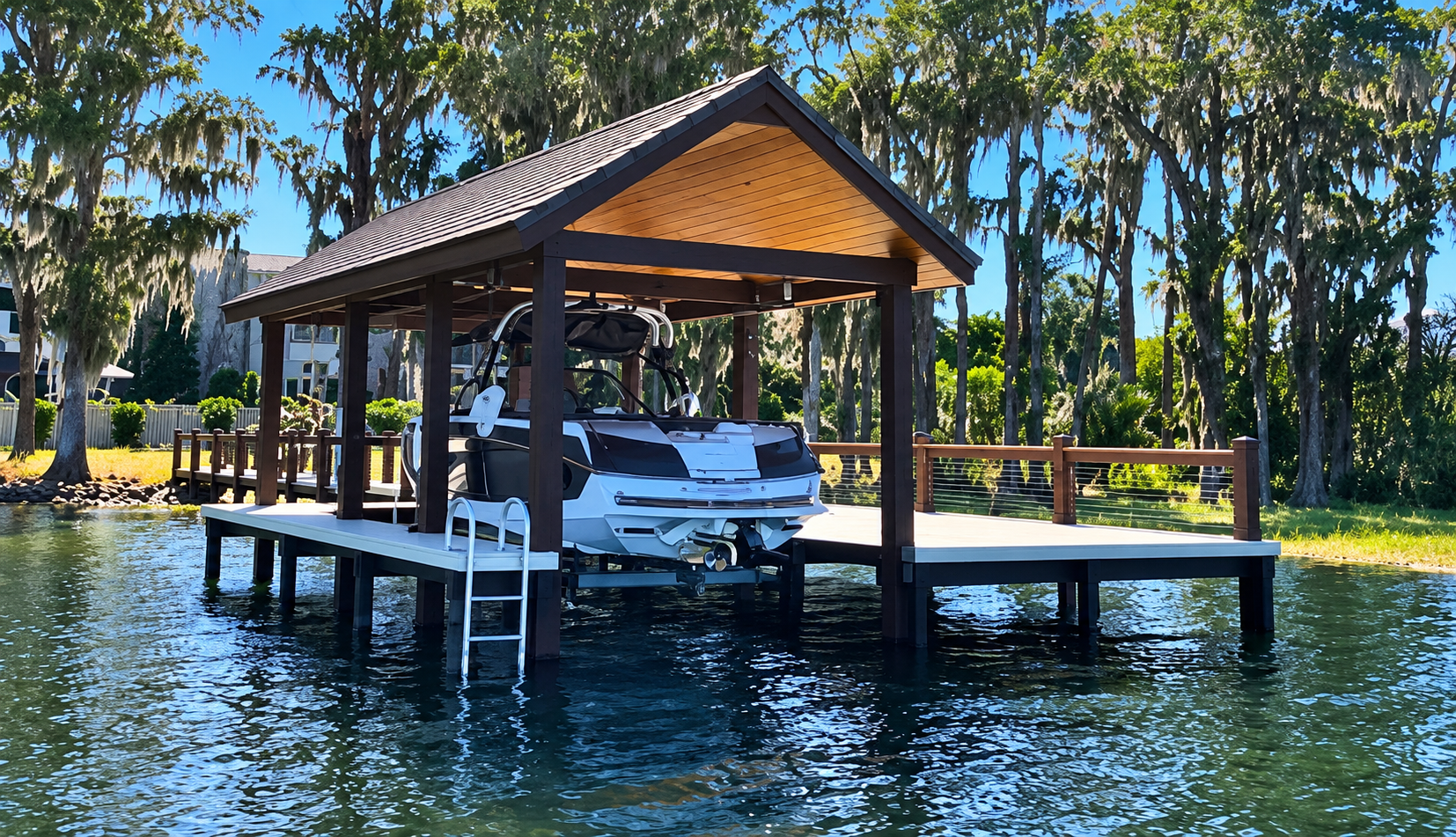
The starting point is always capacity. A lift has to be sized to your boat’s weight, length, and beam, with margin to spare; sizing a lift too small risks damage to both the lift and the boat, and to the dock framing that carries them. We also factor in your waterway’s conditions — water depth, the distance from the dock to deep water, and the way your boat sits at rest — because those shape which lift works and where it mounts. That assessment is what keeps an installation safe and serviceable instead of a guess.
When boat lift installation is the right choice
A lift is the right addition when you want to protect your hull from prolonged water exposure — keeping the boat dry between trips reduces growth on the hull and the wear that comes from sitting in the water. It is also the right path when you are adding a lift to a new dock, where the framing can be engineered for the lift’s capacity from the start; or when your current lift no longer fits your boat and a replacement is the sensible move.
A lift also changes how you use the dock. With the boat held out of the water, boarding and launching become easier and the area around the dock stays clearer. For owners who use their boat regularly, that convenience is often as important as the hull protection. We help you weigh whether a lift fits your routine rather than treating it as a default.
Options and accessories for a lift
Beyond the lift itself, an installation is where accessory choices come into play. A canopy is optional but recommended — it protects your boat and the lift from sun and debris, and we offer canopy options sized to your lift and boat. LED lighting on the dock and boarding area makes the lift safer to operate after sunset; piling caps and bumpers protect the structure the lift mounts to; and where the lift sits alongside seating or storage, those accessories are coordinated so nothing interferes with the lift’s travel or the boat’s clearance.
The electrical coordination is its own part of the job. A lift needs power and controls, and that work is coordinated as part of the installation rather than treated as an afterthought. We do not present lift installation as licensed electrical contracting; where a project requires it, we coordinate that work as part of the build.
Sizing a lift correctly
A boat lift is sized to your boat’s weight, length, and beam with margin to spare, and to your waterway’s conditions. Sizing too small stresses the lift, the boat, and the dock framing. We assess the load and the waterway before recommending a capacity rather than picking one from a catalog.
Benefits and limitations
The benefit of a lift is protection and convenience. Holding the boat out of the water reduces hull growth and the wear that comes from sitting wet; it makes boarding and launching easier; and it keeps the area around the dock clearer. A well-matched lift, carried by framing engineered for the load, is one of the most useful additions a waterfront owner can make.
The limitation is the dependency. A lift depends on the dock’s structure, on the electrical coordination, and on sizing that matches the boat. An undersized lift, a dock whose framing was not built for the load, or controls that are not coordinated for safe operation all turn a convenience into a problem. That is why we assess capacity and framing before we install, and why we are straightforward when a dock needs reinforcing before a lift can go on it.
How the installation process works
1. Capacity assessment
We assess your boat’s weight, length, and beam, and the conditions of your waterway, to size the lift correctly.
2. Dock structure inspection
We inspect the dock’s framing to confirm it can support the lift and the boat’s combined load — and tell you honestly if it needs reinforcing first.
3. Lift selection and mounting
We select the lift and mount it to the dock, with canopy and cover options sized to the lift and boat.
4. Electrical coordination
We coordinate the power and controls for safe operation, including any work that requires coordination as part of the build.
5. Operation walkthrough
We walk you through safe operation and care, then hand the lift over ready to use.
Preparation and what to expect
Before we start, it helps to know your boat’s specs — weight, length, and beam — and whether you want a canopy. During the installation, expect mounting and electrical coordination activity at the dock, along with any reinforcing the framing needs to carry the load. We coordinate scheduling with you and keep the footprint as tidy as the work allows. Because the lift interacts with the dock structure, the installation is honest about what it finds: if the inspection turns up framing that needs reinforcing, we walk through that added scope with you rather than installing onto a structure that is not ready for it.
Maintenance and aftercare
A lift needs ongoing care to stay safe and serviceable. Cables, hardware, and moving parts should be inspected and serviced periodically; the electrical and controls should be checked; and the structure the lift mounts to should be inspected along with the rest of the dock. After any major storm, an inspection is worthwhile. Ongoing care is available through our Dock Maintenance service, which includes lift and accessory servicing alongside the rest of the structure. We are straightforward about what your lift needs so a small service now does not become a repair later.
Local considerations
Central Florida’s waterways — their depth, their distance from dock to deep water, and their storm exposure — all shape which lift works and how it is mounted. Our published coverage includes Orange, Osceola, Seminole, Lake, and Volusia counties; we confirm coverage for individual properties before committing to an installation. Explore the broader region on our Service Areas page.
Why choose Docks of Orlando
We size a lift to the boat and the waterway before we install, we inspect the dock’s framing before we load it, and we coordinate the electrical and the accessories so the whole assembly works as one. You can see lift work in our project portfolio and learn more about the company on our About page.
Planning a project?
Tell us about your shoreline and goals. We’ll assess the conditions, explain the options, and send a free, no-obligation quote.
Boat Lift Installation — Frequently Asked Questions
Straight answers to the questions customers ask most about boat lift installation.
We match the lift's capacity to your boat's weight, length, and beam, and factor in your waterway's conditions. Sizing a lift too small risks damage to both the lift and the boat.
In most cases, yes. We inspect your dock's structure to confirm it can support the lift and your boat's weight, then handle mounting and electrical coordination.
A canopy is optional but recommended — it protects your boat and the lift from sun and debris. We offer canopy options sized to your lift and boat.